Saturday, September 17, 2011

FW: Ach liebe(n) Christen, seid getrost* (Revised)

Cantemus…


Feed: HYMNOGLYPT
Posted on: Saturday, September 17, 2011 10:31 AM
Author: Matt Carver (Matthaeus Glyptes)
Subject: Ach liebe(n) Christen, seid getrost* (Revised)


Here is my revised translation of "Ach liebe(n) Christen, seid getrost" (D. Spaiser, st. 1, 1521; J. Gigas, sts. 2–6, 1561); M. Erhard; Moritz Landgraf von Hessen: proper tune, or: "Wo Gott der Herr nicht bei uns hält." (1561).


OH, CHRISTIANS dear, be of good cheer,
What need for such despairing?
God's chast'ning rod we should revere
And therefore be declaring:
We surely earned this punishment,
To this each man must give assent,
And none may claim exception.


2. Into Thy hands ourselves we give,
O God, beloved Father,
For 'tis in Thee we move and live;
Here all is futile bother;
While in this dwelling we remain,
All is affliction, grief, and pain,
And we await Thy gladness.


3. Except a corn of wheat shall fall
To earth, it hath no earning:
So must our earthly bodies all
To dust and ash be turning
Ere in that glory they may share
Which Thou, Lord, didst for us prepare
By going to the Father.


4. How can we therefore know dismay
Or dread that death assigned us?
For everyone must die some day—
What blessing then shall find us!—
Like Simeon, our sin confessed,
Our Christ in hand, our dying blest,
Our death a gentle slumber!


5. Look to thy body and thy soul,
Let God the Lord supply thee,
Who sends His host to keep thee whole;
No evil shall come nigh thee.
Yea, like the hen close sheltering
Her chickens underneath her wing,
Such is our Lord's compassion.


6. Alive or dead, 'tis all the same:
We are the Lord's possession.
We are baptized into Christ's name,
Who foils the foe's aggression.
Through Adam death came to us all,
But Christ hath freed us from its thrall,
So let us glorify Him.


(7. Praise God the Father on His throne,
Who graciously adored us
And gave His sole-begotten Son
To death and so restored us,
And praise the Holy Paraclete:
May He be with us when we meet
Our death, and grant us blessing.)


Translation © Matthew Carver, 2009, rev. 2011.


CS TERRY:
1. Be of good cheer, good Christians all,
Why stand ye so dejected?
What though our God afflicteth us
Who've His right laws rejected?
How justly falls His chastening hand!
With contrite heart we understand
And bow to His correction


3. E'en as the grain to earth doth fall
And rise to harvest from its tomb,
So must our body vile decay
And dust and ashes brief become,
If glorified it hopes to rise
To those far mansions in the skies
Where Christ hath gone before us.


6. For, though we wake and though we sleep,
The Lord will ever shield us;
Who hath baptized us in His Name
To Satan will not yield us.
Through Adam's sin death on us came.
But Christ the Victim's borne the blame.
Praise God for His great goodness!


GERMAN
1. Ach liebe Christen, seid getrost,
wie tut ihr so verzagen?
Weil uns der Herr heimsuchen tut,
laßt uns von Herzen sagen:
Die Straf' wir wohl verdienet han,
das muß bekennen jedermann,
niemand darf sich ausschließen.


2. In deine Hand uns geben wir,
o Gott, du lieber Vater,
denn unser Wandel ist bei dir,
hier wird uns nicht geraten.
Weil wir in dieser Hütte sein,
ist nur Elend, Trübsal und Pein,
bei dir der Freud' wir warten.


3. Kein' Frucht das Weizenkörnlein bringt,
es fall' denn in die Erden:
so muß auch unser ird'scher Leib
zu Staub und Asche werden,
eh' er kommt zu der Herrlichkeit,
die du, Herr Christ, uns hast bereit't
durch deinem Gang zum Vater.


4. Was wollen wir denn fürchten sehr
den Tod auf dieser Erden?
Es muß einmal gestorben sein,
O wohl ist hier gewesen,
|welcher wie Simeon entschläft,
sein Sünd' erkennt, Christum ergreifst!
so muß man selig sterben


5. Dein' Seel' bedenk', bewahr dein'n Leib,
laß Gott den Vater sorgen,
sein' Engel deine Wächter sein,
b'hüt'n dich vor allem Argen.
Ja, wie die Henn' ihr' Küchelein
bedeckt mit ihren Flügelein,
so tut der Herr uns Armen.


6. Wir wachen [hie] od[e]r schlafen ein,
so sind wir doch [/ja] des Herren.
Auf Christum wir getaufet sein,
der kann dem Satan wehren.
Durch Adam auf uns kommt der Tod,
Christus hilft uns aus aller Not,
drum loben wir den Herren


(7. Gelobt sei Gott im höchsten Thron,
der Vater aller Gnaden,
der uns aus Lieb gegeben hat
sein Sohn für unsern Schaden
gelobt der Tröster Heilig Geist:
wollt uns am letzten End beistehn,
und helf uns selig sterben. Amen.)


View article...

FW: Dicimus grates tibi

Cantemus…


Feed: HYMNOGLYPT
Posted on: Thursday, September 15, 2011 2:21 PM
Author: Matt Carver (Matthaeus Glyptes)
Subject: Dicimus grates tibi


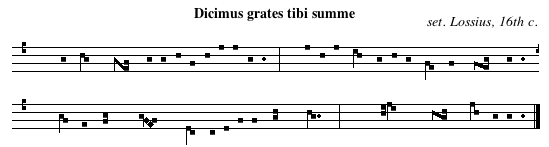
Here is my translation of "Dicimus grates tibi summe rerum Conditor" (P. Melanchthon, 1539) from the Latin rather than from the German paraphrase by Paul Eber (†1569; translations of that have been made by Seiss and Cronenwett). This one preserves the 11.11.11.5 meter. I provide the melody from Lossius Psalmodia (1579):


THANKS UNTO THEE, O highest Lord, Creator,
We for Thy faithful ministers now render,
Whose host Thine hand as flames of fire created,
Holy and blameless.

2. Of Thine own light they shine with radiant glory,
Ever Thy face with raptured gaze beholding,
From Thee Thy words and heav'nly wisdom drawing,
Filled by their Fountain.

3. Thou dost not suffer this Thy holy people
Idly to throng, nor futilely to flutter
Round the vast realms of ether, nor unheeding
Through winds to frolic.

4. Them hast Thou bidden to be Christ's attendants,
And to defend the gath'ring of the godly,
Duly revering all Thy holy statutes,
Tending their teaching.

5. For hotly burning with ungodly hatred,
Against Thy camp, the dragon, ever furious,
Wages his war, by whom both sin and dying
This world first entered.

6. Here seeks he naught but ruin and destruction
Of house and city, church and congregation,
And every thought of Law and fitting conduct:—
Fain would he raze them.

7. Yet o'er us watch the heav'nly troops of angels
Following Christ, their Captain and Commander,
Curbing the cruel weapons of the dragon,
Where'er he rages.

8. Angels saved Lot from Sodom's devastation,
Harbored Elisha from the hostile armies;
Ringed round by angels, he beheld unfearing
Banners of battle.

9. Safe mid the circling lions stood the prophet
Daniel, surrounded by a hedge of angels;
Thus doth God ever by His faithful servants
Keep us all covered.

10. Of Thy protection we would now be mindful,
As unto Thee our choirs, their voices blending
With choirs angelic, thankful anthems render,
O kind Creator.

11. Set these Thy watchmen o'er Thy temple ever,
And o'er Thy people, which esteems as sacred
The Word of Christ, Thy Son; this we beseech Thee
With all devotion.

Translation © Matthew Carver, 2011.

LATIN

1. Dicimus grates tibi, summe rerum
Conditor, gnato tua quod ministros
Flammeos finxit manus angelorum
Agmina pura.

2. Qui tuae lucis radiis vibrantes
Te vident laetis oculis, tuasque
Hauriunt voces, sapientiaeque
Fonte fruuntur.

3. Hos nec [non] ignavum sinis [finis] esse vulgus,
Nec per ingentes volitare frustra
Aetheris tractus, temere nec inter
Ludere ventos.

4. Sed jubes Christo comites adesse
Et pios caetus hominum tueri,
Qui tuas leges venerantur, atque
Discere curant.

5. Impiis ardens odiis et ira
Nam tuis castris draco semper infert
Bella, qui primis scelus atque mortem
Intulit orbi.

6. Hic domos, urbes, tua templa, gentes
Et tuae legis monumenta tota
Et bonos mores abolere tentat
Funditus omnes.

7. Interim sed nos regit angelorum,
Quae ducem Christum sequitur, caterva,
Atque grassantis reprimit cruenta
Arma draconis.

8. Angeli Lothon Sodomae tuentur,
Inter infestos Elisaeus [C…] hostes,
Angelis cinctus, nihil extimescit
Bellica signa.

9. Tutus est inter medios leones,
Angelis s(a)eptus Daniel propheta:
Sic tegit semper Deus his ministris
Omnia nostra.

10. Hoc tuum munus celebramus una,
Et tibi noster chorus angelique
Gratias dicunt simul accinentes,
Conditor alme.

11. Et tuo templo vigiles ut addas
Angelos semper, populoque, Gnati
Qui tui verbum colit, obsecramus
Pectore toto.


View article...

Wednesday, September 14, 2011

FW: Lutheran Mythbusting: The Empty Cross is Lutheran. The Crucifix is Roman Catholic.

Consider…


Feed: Cyberbrethren Lutheran Blog Feed
Posted on: Wednesday, September 14, 2011 12:24 PM
Author: Paul T. McCain
Subject: Lutheran Mythbusting: The Empty Cross is Lutheran. The Crucifix is Roman Catholic.


I was reading some comments a person made about what represents Christ's love best in Lutheranism. He said: "Christ's love in Lutheranism is represented by the empty Cross…" Ah, no. There's nothing wrong with a plain cross symbol, but the plain or "empty" cross is not somehow a "Lutheran" symbol, as opposed to the crucifix. In fact, the crucifix enjoys a very long use in Lutheranism. Here's more information from The Lutheran Church—Missouri Synod's web site.

Q.  Question: Is the use of crucifixes a Roman Catholic practice? Doesn't the empty cross provide a better symbol for Lutherans? How does the LCMS feel about using a crucifix in church? [Note: A crucifix is a cross with a statue of the crucified Christ on it].

A.  A common misunderstanding among some some Lutherans is the opinion that a crucifix, or the use of a crucifix, is a "Roman Catholic" practice. The history of Lutheranism demonstrates that the crucifix was a regular and routine feature of Lutheran worship and devotional life during Luther's lifetime and during the period of Lutheran Orthdoxy. It was also the case among the founding fathers of the Lutheran Church—Missouri Synod. If you were to visit most of the original congregations of the LCMS here in the United States you would find lovely crucifixes adorning their altars, and in addition, beautiful statues on the altar of Christ and the four evangelists, or other such scenes. There is nothing uniquely Roman Catholic about this.  Many Lutherans and Lutheran congregations use crucifixes. Crucifixes are used in the chapels of both of our seminaries.

Lutheranism has always considered the crucifix to be a powerful reminder of the sacrifice our Lord Jesus made for us and our salvation, on the cross. A crucifix vividly brings to mind the Apostle Paul's divinely inspired words, "We preach Christ and Him crucified"  (1 Cor. 1:23).

Interestingly enough, while there is certainly nothing "wrong" with an "empty" cross, the practice of using an "empty cross" on a Lutheran congregation's altar comes more from non-Lutheran sources. At the time of the Reformation there was conflict between Lutherans and Reformed Christians over the proper place of pictures, images, statues and the like in the church. Lutherans stood with historic Christendom in realizing that such art in the church was not wrong, and was a great aid for helping to focus devotional thoughts on the truths of the Word of God, no greater truth can be found that the death of Jesus Christ our Lord for the world's salvation.

The "empty cross" is not a symbol of Christ's resurrection, as some say, for the fact is that the cross would have been empty regardless of whether or not Christ had risen from the grave. The point to be kept clear here is that both an "empty cross" and a crucifix, symbolize the same thing: the death of Christ our Lord for the salvation of the world. Many feel that the crucifix symbolizes this truth more clearly and strikingly. That has been the traditional opinion of historic Lutheranism, until the last fifty years ago, due to the influence we will now mention.

Some Lutherans began to move away from crucifixes during the age of Lutheran Pietism, which rejected much of Lutheran doctrine and consequently many Lutheran worship practices. At the time, Lutheran Pietists, contrary to the clear postion of Luther and the earlier Lutherns, held that symbols such as the crucifix were wrong. This was never the view of historic Lutheranism.  Here in America, Lutherans have always felt a certain pressure to "fit in" with the Reformed Christianity that predominates much of the Protestant church here. Thus, for some Lutherans this meant doing away with things such as crucifixes, and vestments, and other traditional forms of Lutheran worship and piety. It is sad when some Lutherans are made to feel embarrassed about their Lutheranism by members of churches that teach the Word of God in error and who do not share Lutheanism's clear confession and practice of the full truth of the Word of God.

Lutheranism has always recognized that the use of any symbol (even the empty cross) can become an idolatrous practice, if in any way people are led to believe there is "power in the cross" or that a picture or representation of a cross has some sort of ability, in itself, to bring us into relationship with Christ and His Gospel. Any of God's good gifts can be turned against Him in this life and become an end in themselves.

Lutherans have never believed that banning or limiting proper artwork in the church is the way to prevent its improper use. Rather, we believe that proper teaching and right use is the best way, and the way that is in keeping with the gift of freedom we have in Christ to use all things to the glory and honor of God. Thus, many Lutherans use and enjoy the crucifix as a meaningful reminder of our Lord's suffering and death. It might interest you to know that our Synod's president has a beautiful crucifix adorning the wall of his office, constantly reminding him and visitors to his office of the great love of God that is ours in Christ Jesus our Lord.

In short, and this is the most important point of all: there is nothing contrary to God's Holy Word, or our Lutheran Confessions, about the proper use of the crucifix, just as there is nothing wrong with the proper use of an empty cross, or any other church symbol by which we are reminded of the great things God has done for us. We need to guard against quickly dismissing out of hand practices that we believe are "too Roman Catholic" before we more adequately explore their use and history in our own church.

In Christian freedom, we use either the crucifix or an empty cross and should not judge or condemn one another for using either nor not using either symbol of our Lord's sacrifice for our sins.

Here are quotes from Martin Luther on crucifixes, images and making the sign of the cross:

The custom of holding a crucifix before a dying person has kept many in the Christian faith and has enabled them to die with a confident faith in the crucified Christ.

(Sermons on John, Chapters 1-4, 1539; LW, Vol. XXII, 147)

It was a good practice to hold a wooden crucifix before the eyes of the dying or to press it into their hands. This brought the suffering and death of Christ to mind and comforted the dying. But the others, who haughtily relied on their good works, entered a heaven that contained a sizzling fire. For they were drawn away from Christ and failed to impress His life-giving passion and death upon their hearts.

(Sermons on John, Chapters 6-8, 1532; LW, Vol. XXIII, 360)

[W]hen I hear of Christ, an image of a man hanging on a cross takes form in my heart, just as the reflection of my face naturally appears in the water when I look into it. If it is not a sin but good to have an image of Christ in my heart, why should it be a sin to have it in my eyes?

(Against the Heavenly Prophets, 1525; LW, Vol. 40, 99-100)

IMAGES AND STATUES OF SAINTS

Now we do not request more than that one permit us to regard a crucifix or a saint's image as a witness, for remembrance, as a sign as that image of Caesar was. Should it not be as possible for us without sin to have a crucifix or an image of Mary, as it was for the Jews and Christ himself to have an image of Caesar who, pagan and now dead, belonged to the devil? Indeed the Caesar had coined his image to glorify himself. However, we seek neither to receive nor give honor in this matter, and are yet so strongly condemned, while Christ's possession of such an abominable and shameful image remains uncondemned.

(Against the Heavenly Prophets, 1525; LW, Vol. 40, 96)

And I say at the outset that according to the law of Moses no other images are forbidden than an image of God which one worships. A crucifix, on the other hand, or any other holy image is not forbidden.

(Ibid., 85-86)

Where however images or statues are made without idolatry, then such making of them is not forbidden.

[M]y image breakers must also let me keep, wear, and look at a crucifix or a Madonna . . . as long as I do not worship them, but only have them as memorials.

(Ibid., 86, 88)

But images for memorial and witness, such as crucifixes and images of saints, are to be tolerated . . . And they are not only to be tolerated, but for the sake of the memorial and the witness they are praiseworthy and honorable . . .

(Ibid., 91)

SIGN OF THE CROSS

Morning Prayer

In the morning, when you get up, make the sign of the holy cross and say:

In the name of the Father and of the Son and of the Holy Ghost. Amen . . .

In the evening, when you go to bed, make the sign of the holy cross and say:

In the name of the Father and of the Son and of the Holy Ghost. Amen.

(Small Catechism, 1529, Section II: How the Head of the Family Should Teach His Household to Pray Morning and Evening, 22-23)

Thus has originated and continued among us the custom of saying grace and returning thanks at meals, and other prayers for both morning and evening. From the same source came the practice with children of crossing themselves in sight or hearing of terrifying occurrences . . . .

(Large Catechism, 1529, The Second Commandment, section 31, p. 57)

If the devil puts it into your head that you lack the holiness, piety, and worthiness of David and for this reason cannot be sure that God will hear you, make the sign of the cross, and say to yourself: "Let those be pious and worthy who will! I know for a certainty that I am a creature of the same God who made David. And David, regardless of his holiness, has no better or greater God than I have."

(Psalm 118, LW, Vol. XIV, 61)

If you should have a poltergeist and tapping spirit in your house, do not go and discuss it here and there, but know that it is not a good spirit which has not come from God. Cross yourself quietly and trust in your faith.

(Sermon for the Festival of the Epiphany, LW, Vol. 52, 178-79)

Bibliography of Primary Sources

Large Catechism, 1529, translated by John Nicholas Lenker, Minneapolis: Augsburg Publishing House, 1935.

Luther's Works (LW), American edition, edited by Jaroslav Pelikan (volumes 1-30) and Helmut T. Lehmann (volumes 31-55), St. Louis: Concordia Pub. House (volumes 1-30); Philadelphia: Fortress Press (volumes 31-55), 1955.

Small Catechism, 1529, St. Louis: Concordia Publishing House, 1943.


View article...

FW: Closed Communion question

Consider…


Feed: Cranach: The Blog of Veith
Posted on: Wednesday, September 14, 2011 4:00 AM
Author: Gene Veith
Subject: Closed Communion question


I know that the confessional Lutheran practice of "closed communion," in which you have to be a member of the church body (or a member of a church in formal doctrinal fellowship with that church body) to commune at the Lutheran altar, is offensive to many non-Lutherans.  I don't particularly want to debate that practice, which we've talked about extensively.  Rather, I would like to ask those of you who are offended some questions:  Have you ever been to a Roman Catholic mass or an Eastern Orthodox divine liturgy?  Perhaps you attended a funeral or a wedding or had an assignment in a religion course or dropped in on a service for one reason or another.   Were you offended because you could not commune?  Did you expect to?  Did you even want to, given your theological reservations about what was going on?

Though some Roman Catholic priests will commune anyone, this is strictly forbidden by canon law.  I would say that there are proportionally more Missouri Synod Lutheran pastors who practice open communion, even though it is against denominational policy, than there are Catholic priests who do it.  And, as an Orthodox commenter helpfully observed in one of our earlier threads, you will come close to never finding open communion practiced in an Eastern Orthodox church.

Used to, one's membership in a particular theological tradition was defined by whom you would take communion with.   Then we had the ecumenical movement, largely among Protestants, and different churches–usually highly liberal–started sharing Communion with everyone.

Anyway, my impression is that few people feel insulted when they don't join Catholics or Orthodox in their sacramental rites.  After all, we think, I'm not Catholic or Orthodox.

So why is it different with Lutherans?


View article...

FW: The Call Of God Ordained You

Cantemus…


Feed: starke Kirchenlieder
Posted on: Tuesday, September 13, 2011 9:33 PM
Author: Stephen P. Starke
Subject: The Call Of God Ordained You


This text was written for the 25th ordination anniversary and retirement of Pastor Richard A. Bolland.  It is set to the tune VON GOTT WILL ICH NICHT LASSEN  (LSB 713)

1.   The call of God ordained you
     A watchman for the Lord!
     Each day God has sustained you,
     To be His people's ward,
     His counsel to proclaim:
     The Law—its condemnation;
     The Gospel—its salvation
     For all in Jesus' name.
   
2.  The Lord does not desire
     That any die in sin;
     Instead He would inspire
     True change of heart within,
     And so He sends His Word—
     That all might be repenting,
     Their judgment thus preventing
     For wickedness incurred.

3.  How unforeseen that power
     Christ resurrected showed,
     When in that evening hour
     His Spirit He bestowed:
    "The sins that you forgive,
     They truly are forgiven,
     On earth and high in heaven."
     Each penitent shall live!

4. "The sins you are retaining
     Before the Father's face,
     Are debts by those disdaining
     My Father's heart of grace."
     Yet these Christ would receive:
    "How often, yes, how often,
     I prayed your heart would soften
     And you your sin would leave."

5.  The watchman's voice is crying,
    "Turn from your evil way!"
     Still some, his call defying,
     Resist and disobey.
     You died for these, Lord, too!
     Your mercy is most shocking;
      It seeks to save the mocking
     Who know not what they do.

6.  The watchman's sacred duty
     Proclaims good news from God;
     His feet are rare with beauty
     And with the Gospel shod.
     God's spokesman lifts his voice:
    "Those marred by sin's defiling,
     God's grace is reconciling.
     Return! Believe! Rejoice!"

7.  You, son of man, unswerving,
     Have spoken for the Lord.
     We, whom you have been serving,
     Thank God with one accord!
     We say so gratefully:
    "Dear watchman, you have led us;
     Dear pastor, you have fed us—
     To God all glory be!"


View article...

Tuesday, September 13, 2011

FW: Luther On Law

Consider…


Feed: Tullian Tchividjian
Posted on: Monday, September 12, 2011 7:00 AM
Author: Tullian Tchividjian
Subject: Luther On Law


Ok, get ready to do some real thinking here. What follows is heavy theological lifting.

I asked my friend Jono Linebaugh to weigh in on the recent discussion about Law and Gospel. His thinking is solid. His nuances are crucial. He adds serious depth to this ongoing conversation. Much food for thought here.

Jono recently joined the Faculty at Knox Theological Seminary (the seminary owned by Coral Ridge). He graduated from Messiah College, Trinity Episcopal School for Ministry, and then earned his PhD from Durham University studying Pauline Theology. He's published articles in the following leading academic journals: New Testament Studies, Early Christianity, and Studia Patristica.

He was a two-time college All-American in lacrosse and he surfs (which is the real reason he was hired at Knox). He's 29, married to Megan, has two children (Liam and Callie) and one on the way.

Enjoy…

————————————————————————————————————————————————————–

Reading some of the recent discussions about Law and Gospel, I was reminded of one of the conclusions of Gerhard Forde's book The Law-Gospel Debate: "when participants in the debate speak of law, they may be speaking of quite different things." My own situation may be too ambiguous to offer much by way of clarification (I'm an Anglican teaching at a Reformed seminary writing on Luther!). But moving conversations forward often requires taking a step back–and returning to the thinker who introduced and emphasized the theological concept of "uses of the law" seems like a good place to start.

In a treatise from 1520, "The Freedom of a Christian," Luther stated an essential element of his theology: "the entire Scripture of God is divided into two parts: commandments [Law] and promises [Gospel]." The basic distinction is straightforward: the Law tells us what we ought to do; the Gospel tells us what God has given. At this level – what Luther called the "level of words" – "There is no one so stupid that he does not recognize how definite this distinction between Law and grace is." At a more basic level, however – what Luther called "the level of reality and experience" – this distinction "is the most difficult thing there is" (Galatians 1535). There are two reasons why this simple linguistic distinction is an existential difficulty. First, and for Luther most importantly, when a Christian is aware of and afflicted by their sin, it is "the most difficult thing in the world" to let the conscience listen to the voice of Christ rather than the condemnation of the Law. Second, the distinction between Law and Gospel is ultimately – that is, in reality – not a distinction between what is said; it is a distinction between what is heard; or more precisely it is a difference between whether God's verbal encounter with the human effects condemnation and death or works faith, forgiveness, and freedom. Thus, for Luther, the same words can be heard as either Law or Gospel. For example, the 10 Commandments are both the "hammer of God" that terrifies sinners with the "thunder of Mt. Sinai" and the pure promise that "I am the Lord your God." Conversely, the beautiful and basic words of the Gospel – "Christ died for your sins" – can be, to the ears of unbelief, nothing but an announcement of the "enormity of God's wrath" (Against the Antinomians 1539). An awareness of the doubleness of the distinction between Law and Gospel – a distinction that is so simple that the "stupid" recognize it and so difficult an art that "only the Holy Spirit practices it" (Galatians 1535) – forces us to step back and ask about Luther's theological definition of Law.

God's Use of God's Good Law

"But we know that the Law is good, if one uses it rightly." For Luther, this short sentence from 1 Timothy 1.8 reveals two things about the Law: first, it is good; second, it has a proper use. The goodness of the Law is emphatically affirmed in Romans 7.12 ("the Law is holy, righteous, and good") and is a frequent refrain in the Psalms. The proper use of the Law is specified in 1 Timothy 1.9 ("the law is not given for the righteous but for the lawless and disobedient, for the ungodly and the sinner") and its function and effect is detailed in Romans: the law makes the whole world guilty before God (3.19), works wrath (4.15), increases sin (5.20), and, as a weapon in the hand of Sin, kills (7.11).

Taking his cues from Paul, Luther described the Law as good – as "the most salutary doctrine of life" (Heidelberg Disputation, Thesis 1) – and he defined the Law in terms of its function: "when the Law is being used correctly, it does nothing but reveal sin, work wrath, accuse, terrify, and reduce the minds of men to the point of despair" (Galatians 1535). Thus, following the pattern of 1 Tim 1.8, Luther affirms both "that the Law is good and useful" and that this is only the case "in its proper use" (Galatians 1535). What this means is that, for Luther, the Law is not primarily a moral codex (e.g. the Mosaic Law) or a grammatical pattern (e.g. imperatives); Law is a theological term that describes one of two ways that God encounters humans verbally. In other words, Law names the event of divine speech that condemns sin and kills sinners. As one of the Lutheran confessions puts it, "Law is everything that proclaims something about sin and God's wrath" (Formula of Concord, Solid Declaration).

Two important implications follow from this theological definition of Law. First, because Law is a way of identifying God's action with words, talk about "uses" of the Law cannot be human uses of the Law but God's use of his Law. In other words, God is the acting subject; he wields the words of death and life and the theological term Law is a way of pointing to God's accusing, condemning, and killing speech. Second, because Law is defined in terms of its function and effect rather than simply its content, it is not, as noted above, reducible to a moral codex or a grammatical pattern. This means that the common assumption that "imperative = Law" is far too static an equation. There seems to be some persistent confusion on this last point, so it is worth teasing out Luther's perspective a little more.

No Condemnation and the End of Conditionality

God's words that accuse and kill typically do their work of condemnation in the form of a commandment attached to a condition. So, for example, when Paul sums up the salvation-logic of the Law he quotes Leviticus 18.5b: "the one who does [the commandments] will live by them" (Gal 3.12). Here, there is a promise of life linked to the condition of doing the commandments and a corresponding threat: "cursed is everyone who does not abide in all the things written in the Book of the Law, to do them" (Gal 3.10 citing Deut 27.26). When this conditional word encounters the sinful human, the outcome is inevitable: "the whole world is guilty before God" (Rom 3.19). It is thus the condition that does the work of condemnation. "Ifs" kill!

Compare this to a couple examples of New Testament imperatives. First, consider Galatians 5.1. After four chapters of passionate insistence that justification is by faith apart from works of the Law, Paul issues a couple of strong imperatives: "It was for freedom that Christ set us free; therefore stand firm (imperative) and do not be subject (imperative) again to the yoke of slavery." Are these imperatives instances of God's accusing and killing words? Are these commandments with conditions? Is Galatians 5.1 an example of Law? No! The command here is precisely to not return to the Law; it is an imperative to stand firm in freedom from the Law. Or take another example, John 8.11. Once the accusers of the adulterous women left, Jesus said to her, "Neither do I condemn you. Depart. From now on, sin no more." Does this final imperative disqualify the words of mercy? Is this a commandment with a condition? Is this Law following the Gospel? No! This would be Law: "if you go and sin no more, then neither will I condemn you." But Jesus said, "Neither do I condemn you. Go and sin no more." The command is not a condition. "Neither do I condemn you" is categorical and unconditional, it comes with no strings attached. "Neither do I condemn you" creates an unconditional context within which "go and sin no more" is not an "if." The only "if" the Gospel knows is this: "if anyone sins, we have an advocate with the Father, Jesus Christ the Righteous" (1 John 2.1).

For Luther, it is within this unconditional context created by the gospel, the reality he called "living by faith," that the Law understood as God's good commands can be returned to its proper place. Freed from the burden and bondage of attempting to use the Law to establish our righteousness before God, Christians are free to look to commandments, not as conditions, but as descriptions and directions as they seek to serve their neighbor. In other words, once a person is liberated from the commonsense delusion that acting righteously makes us righteous before God, and in faith believes the counter-intuitive reality that being made righteous by God's forgiving and resurrecting word precedes and produces righteous action, then the justified person is unlocked to love.

For this reason, Luther would insist that the Law only applies to the second question of Christian living: what shall we do? It helps to answer the "what" question, the question about the content of good works. The Law, however, does not answer the more basic question, the question far too few people ask: How do good works occur? What fuels works of love? While the Law demands and directs, what delivers and drives? For Luther, the answer to this question always follows the pattern of 1 John 4.19: "We love because he first loved us." Works of love flow from prior belovedness. Thus, as Lutheran theologian Oswald Bayer has said, the essential question of theological ethics is this: "What has been given?" The answer: "God shows his love for us in that while we were still sinners Christ died for us" (Rom 5.8).

A Third Use of the Law?

Recognizing this distinction between the conditional and condemning function of the Law and the descriptive and directive statement of God's will addressed to the unconditional context of faith in the God who justifies the ungodly is essential for understanding the purpose and place of New Testament imperatives, not to mention the Ten Commandments. The proper pattern is always "in view of God's mercies…" (Rom 12.1), or as Luther pointed out with respect to the Decalogue, the pattern is the opening promise: "I am the Lord your God…" (Exod 20.2). In other words, the ears of faith are free to hear a commandment without a condition because the Christian conscience listens not to the condition and curse of the Law, but to the Christ in whom there is no condemnation (Rom 8.1).

This is why, for Luther, the phrase "the third use of the Law" is a category mistake. For him, as suggested above, Law names the divine speech that accuses and kills. Cut off from its conditionality and kicked out of the Christian's conscience, a commandment is not Law in the theological sense. This does not mean that Luther didn't think those portions of scripture that we think of as Law should be preached to Christians; he emphatically did (as his disputations against the Antinomians and his expositions of the Ten Commandments in the Catechisms demonstrate). But it does mean that "Law" is a slightly misleading term in this context because Law, for Luther, is defined by its "chief and proper use" which is "to reveal sin" and function as a "Hercules to attack and subdue the monster" of self-righteousness (Galatians 1535). Defined this way, Law only applies to the Christian insofar as they are still sinful. (For Luther, a third use of the Law – a phrase his younger colleague Melanchthon coined in 1534 and which Luther never adopted – can only mean that the first two uses still apply to the Christian because while they are righteous they are simultaneously sinful).  Insofar as the Christian is justified by faith, however, the Law has ended – and precisely because the Law has ended as a voice of condemnation, because it has been divested of its saving significance, a commandment can be heard by the ears of faith without a condition. Passive and receptive before God, the justified person is free to be active and giving toward the neighbor.

The end of the Law (Rom 10.4), understood by Luther as Christ kicking the Law out of the conscience and rejecting its role as the regulator of the divine-human relationship, is thus the end of the "ifs" that interpose themselves between God and his creatures. In place of the "ifs" Christ has uttered a final cry: "It is finished." These three words are the unconditional guarantee of the three words God speaks to sinners in the Gospel: "I love you." In this unconditional context the justified person is freed from the inhuman quest to secure a standing before God and freed for the human task of serving one's neighbor. In Luther's memorable words: "A Christian is a perfectly free Lord of all, subject to none. A Christian is a perfectly dutiful servant of all, subject to all" (Freedom of a Christian 1520)

Listen for the Creature

A word of caution from Luther by way of conclusion: it is one thing to affirm that the gospel creates a secure space within which a command can be heard without a condition; it is another thing altogether to issue a command that is not heard as a condition. This is why Luther was always saying that "as far as the words are concerned…everyone can easily understand the distinction between the Law and grace, but so far as practice, life, and application are concerned, it is the most difficult thing there is" (Galatians 1535). In other words, there will always be a temptation to preach or teach what could or should be – that is, a context in which a command is not a condition – without attending to the way such a command is still heard as Law – as an "if" and thus as judgment – by the sinful, doubting human.

For this reason, distinguishing Law and Gospel in real life requires a double listening. First, as we attend to God's word, we listen for the "if" that accuses and kills and the "nevertheless" that forgives and makes alive. Second, in Luther's deeply pastoral phrase, we "listen for the creature, i.e. sinful humanity." When God's word is spoken and heard as forgiveness without any "ifs," then we know God is speaking Gospel. It is no surprise, then, that Luther referred to the practice of distinguishing Law and Gospel as the highest art, an art that "none but the Holy Spirit" practices because he alone is "intent on using the Law and preaching the Gospel" (Galatians 1535).


View article...

FW: Christe sanctorum decus (corr. H. Bonnus)

Cantemus…


Feed: HYMNOGLYPT
Posted on: Sunday, September 11, 2011 6:29 PM
Author: Matt Carver (Matthaeus Glyptes)
Subject: Christe sanctorum decus (corr. H. Bonnus)


Here is my translation of Hermann Bonnus' correction to Rabanus Maurus' hymn for the Feast of St. Michael and All Angels. I have attempted to translate it twice, on the basis of each commonly used versions, one unrhymed and the other rhymed, since the first and last stanzas are largely the same as the original. The sixth stanza is a generic doxology for this meter, apparently from St. Gregory the Great. Since that of Riley is less literal (Dearmer does no better), I have provided an alternate translation, and also direct the reader to the superior doxology provided in the other (Roman use) translation. The following tune is that appointed in Lossius Psalmodia (1579).


Adaptation of English Hymnal #242 (based on A. Riley, 1906):
CHRIST, THE FAIR glory of the holy angels,
Thou who hast made us, Thou who o'er us rulest,
Grant of Thy mercy for our supplications
Steps up to heaven.


2. Give holy angels charge o'er every dwelling,
That they may keep us, standing as our watchmen,
From Satan's foul attacks our souls defending,
His snares dispelling.


3. So make Thy Word proclaimed without perversion,
Nor any sect of doctrine false to flourish,
Lest it succeed our senses in deluding
By faith's appearance.


4. As once Thine Angel Michael was triumphant,
Seizing the vict'ry o'er the prince of Persia,
So make Thy peace once more to dwell among us
E'en at the present.


5. Thine Angel grant to govern all the living,
Lending support in all our earthly labors
That in their sum they may to Thee be pleasing:
O Christ, we pray Thee.


6. This may the blessed Godhead vouchsafe to us:
Father and Son and Holy Spirit equal,
Whose glory fills the world with fairest echo
Now and forever. (Amen.)


Riley's original doxology:
6. Father Almighty, Son, and Holy Spirit,
God ever blessèd, be Thou our preserver;
Thine is the glory which the angels worship,
Veiling their faces.

Roman translation:
This be our portion [older: This He vouchsafe us…], God forever blessed,
Father eternal, Son, and Holy Spirit,
Whose is the glory, which through all creation
ever resoundeth. (Amen.)


Translation sts. 1, 6 alt., Composite;
sts. 2-6. © Matthew Carver, 2011.


Correction of alternate translation (based on T.I. Ball, 1921):
CHRIST, OF THE Angels praise and adoration,
Maker of all men, Lord of every nation,
Graciously let our earnest pray'r be given
Steps up to heaven.


2. Thy holy angels to our dwellings send us,
Charge them as guardians ever to attend us,
And keep us safe from Satan's wicked cunning,
His ruses stunning.


3. That in all truth Thy Word may be presented,
And any sects of doctrine false prevented,
Lest they by outward piety's pretenses
Ensnare our senses.


4. Michael the Angel, once the rival quelling,
Triumph obtained, Persia's prince repelling,—
Let peace be wrought again amid the foment,
E'en in this moment.


5. May Thy good angel rule and govern o'er us,
And in our labors help and go before us,
That they may please Thee, nor by sin dismay Thee;
This, Christ, we pray Thee.


6. O May the Godhead, endless bliss possessing, 

Father and Son and Spirit, grant this blessing; 

Whose glory, all the universe pervading

Knoweth no fading.


Translation st. 1 Composite, st. 6, 
sts. 2–5 © Matthew Carver, 2011.


BONNUS' CORRECTION

1. Christe, sanctorum decus Angelorum
Auctor humani generis et rector,
Supplices nobis, tribuas rogamus
scandere caelum.


2. Angelos sanctos jubeas ubique
Esse custodes, vigilesque nostros,
Impetus contra Satanae malignos,
Insidiasque.


3. Ut tuum verbum doceatur apte,
Nulla perversi valeatque secta
Dogmatis nostros, pietate ficta,
Fallere sensus.


4. Angelus quondam Michael triumphum
Regibus Persis reparavit, idem
Publicam pacem, tueatur omni
Tempore nobis.


5. Angelus vitam regat universam,
Adjuvet nostros simul et labores,
Cuncta quòd possint tibi comprobari,
Christe precamur.


6. Praestet hoc nobis Deitas beata
Patris ac Nati, pariterque Sancti
Spiritus, cuius reboat per omnem
gloria mundum. (Amen.)


ORIGINAL LATIN

1. CHRISTE, sanctorum decus Angelorum
Rector humani generis et auctor,
nobis aeternum tribue benigne
scandere caelum.


2. ANGELUM pacis, Michael ad istam
caelitus mitte, rogitamus aulam:
nobis ut crebro veniente crescant
prospera cuncta.


3. ANGELUS fortis Gabriel, ut hostem
pellat antiquum, volitet ab alto,
saepius templum veniat ad istud
visere nostrum.


4. ANGELUM nobis medicum salutis
mitte de caelis Raphael, ut omnes
sanet aegrotos, pariterque nostros
dirigat actus.


5. HINC Dei nostri Genetrix Maria,
totus et nobis chorus Angelorum
semper assistat, simul et beata
concio tota.


6. PRAESTET hoc nobis Deitas beata
Patris ac Nati pariterque Sancti
Spiritus, cuius resonat per omnem
gloria mundum. Amen.


LATIN, REVISED USE:

1. Christe, sanctorum decus Angelorum,
Gentis humanae sator et redemptor,
Coelitum nobis tribuas beatas
Scandere sedes.


2. Angelus pacis Michael in aedes
Coelitus nostras veniat, serenae
Auctor ut pacis lacrimosa in orcum
Bella releget.


3. Angelus fortis Gabriel, ut hostes
Pellat antiquos, et arnica coelo,
Quae triumphator statuit per orbem,
Templa revisat.


4. Angelus nostrae medicus salutis,
Adsit e coelo Raphael, ut omnes
Sanet aegrotos, dubiosque vitae
Dirigat actus.


5. Virgo dux pacis, Genitrixquae lucis,
Et sacer nobis chorus Angelorum
Semper assistat, simul et micantis
Regia coeli.


6. Praestet hoc nobis Deitas beata
Patris, ac Nati, pariterque sancti
Spiritus, cujus resonat per omnem
Gloria mundum.


View article...